Science & AI

The Gosta Clinical AI Factory

Europe’s vertically integrated clinical AI infrastructure — from sovereign foundation model training to governed inference inside hospital walls.

We don’t wrap someone else’s model. We train, distill, deploy, and monitor our own — on European supercomputing, under European regulation, with clinicians in the loop at every layer.

Most healthcare AI is built around closed models. Ours is a factory: five layers of proprietary infrastructure, one continuous learning loop. You can certify a closed model. You can’t retrain it, inspect it, or improve it.

Most Healthcare AI

Interface - owned
Owned
Closed model - rented
Rented
Certifiable — but frozen. What’s inside can’t be opened, and clinician feedback has nowhere to go.
AI management platform - owned
Owned
Multilingual foundation models - owned
Owned
Task-specific expert models - owned
Owned
Clinical model harness - owned
Owned
Clinical feedback flywheel - owned
Owned

Every layer open to us — inspectable, retrainable, and improved by every clinician who uses it.

Five layers. One learning loop.

Every layer of the Gosta Clinical AI Factory is built, owned, and operated by Gosta — from the governance foundation to the feedback signals flowing back from live clinical use. Intelligence builds up from the foundation. Data flows back from live care. The loop never stops.

Unified AI Management PlatformMultilingual Clinical Foundation ModelsTask-Specific Expert ModelsClinical Model HarnessClinical Feedback Flywheel
  • AI Management System ISO/IEC 42001

  • EUMDR pathway: architecture built for Class IIa medical device certification

  • EU AI Act-compliant data governance

  • EU AI Act-compliant data governance

Everything above runs on our proprietary AI and data governance platform for healthcare - the system of record for every model, version, approval, and audit trail. Compliance isn’t a checklist we run at the end; it’s the foundation the factory is built on.
  • Synthetic data generation with closed and open frontier models

  • Fine-tuning of open large language models on clinical corpora

  • Physician-in-the-loop annotation, preference ranking, and validation

  • Multilingual by design: Finnish, Swedish, Estonian, French, English

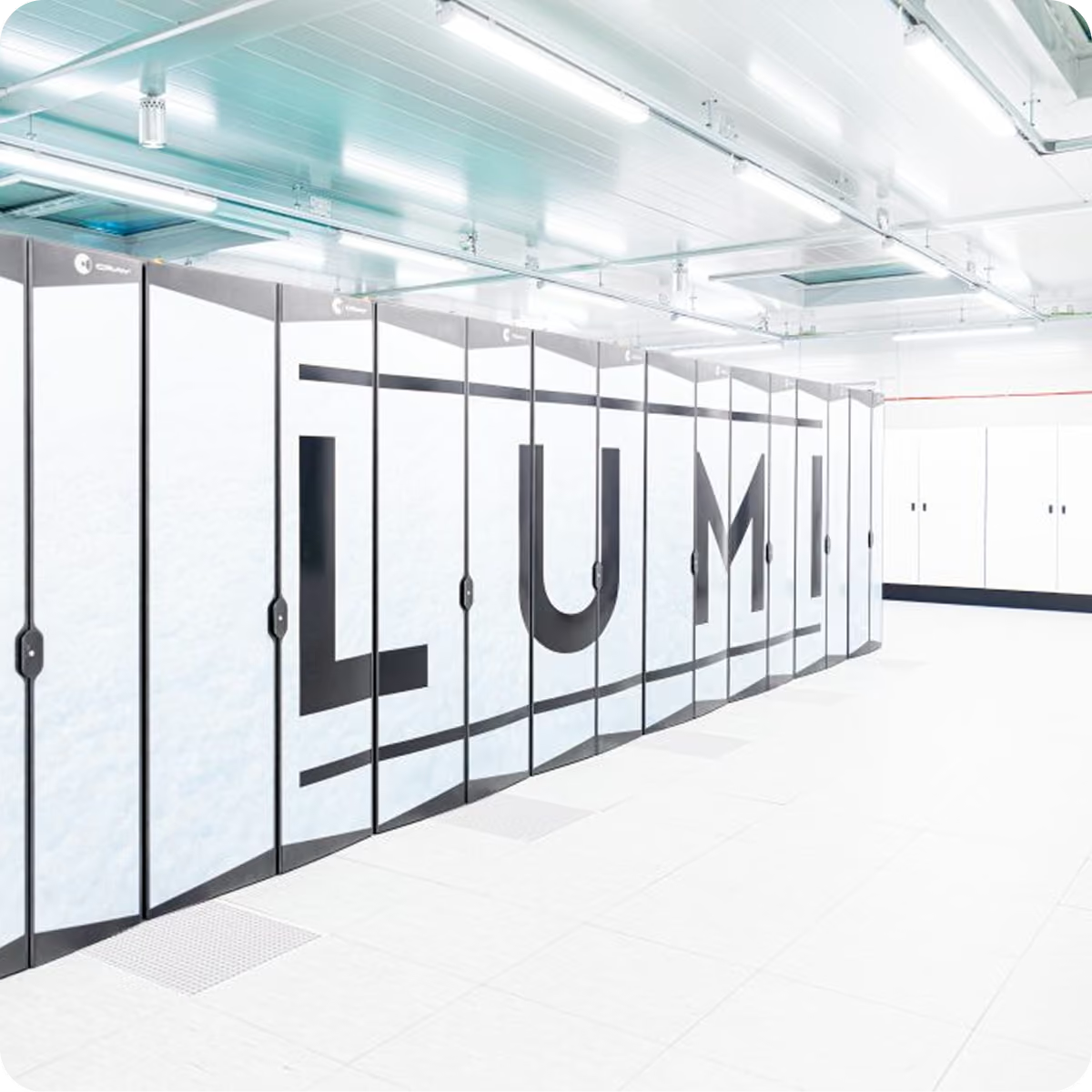
Our foundation models are trained and fine-tuned on LUMI, one of the world’s fastest supercomputers - EU-hosted, with complete data sovereignty. Post-training is physician-in-the-loop: our in-house medical experts annotate, rank, and validate as part of the training pipeline itself. Native clinical performance across five languages, not English models with translation bolted on.
  • Clinical summarization
  • Medical speech-to-text
  • PII removal & deidentification
  • Hallucination detection
  • Medical NER
  • ICD-10/ICD-O coding
  • TNM staging
  • RECIST response assessment
  • ECOG performance status
  • Biomarker extraction
  • Medication extraction
  • Structured clinical extraction
We distill our foundation models into compact specialists — each optimized, validated, and versioned for a single clinical task. Right-sized from lean BERT-scale encoders to 27B+ parameter models, they run fast enough for agentic pipelines and lean enough to live inside a hospital.
  • Intelligent routing across task-specific and foundation models

  • Agentic pipelines composed from certifiable components

  • Inline guardrails: hallucination detection, uncertainty flagging, graceful degradation

Frontier capability means nothing if it can’t survive a Tuesday morning clinic. The harness is our orchestration layer: routing each task to the right model at the right latency, composing agentic pipelines, and running inline safety checks - including hallucination detection - before output ever reaches a clinician.
  • Edit and preference signals captured from live clinical workflows

  • Structured feedback from professionals across every deployment

  • Adaptive flywheel: the more the platform is used, the better every model beneath it becomes

Every clinician interaction is a training signal. Our UI layer streams edit and preference data from real-world clinical conditions into Gosta’s post-training pipelines — preference optimization powered by the people who actually practice medicine, not crowd workers rating text.
Gosta AI Foundation

Train. Deploy. Monitor. Repeat.

The factory is a cycle, not a line. Surveillance findings from live clinical use become retraining data and new success criteria for the next training round on LUMI.

Train - LUMI Supercomputer

Synthetic data generation, fine-tuning, and training of task-specific clinical models on EU-hosted supercomputing with complete control over data privacy.

Deploy - Sovereign Inference

Validated models are served where your data lives. Same models, same governance — the jurisdiction is your choice.

Monitor - Post-Market Suveillance

Performance, output quality, cost, and drift tracked per model, per version. Structured clinician feedback from the live workflow. Every finding loops back into training.

Deploy · choose your jurisdiction

Deploy inside your walls

Deployed entirely inside the hospital’s own environment. Patient data never leaves.

Deploy on sovereign cloud

Hosted on sovereign infrastructure — EU providers under European jurisdiction end to end, or US sovereign infrastructure for American health systems with data-residency requirements.
The Science

A demo is not evidence.

Every model is measured against the clinical success criteria it was commissioned for — before it ever reaches a patient record.

Held-out validation

Every model is tested on separate validation data it has never seen. Benchmark performance is the starting line, not the finish.
Clinical benefit, not just accuracy

We evaluate technical performance and practical benefit: does essential information survive, do fabricated claims appear, does the clinician actually save time?

Explicit contraindications

For every model, we define where it must not be used. Knowing a model’s limits is part of the model.

Controlled release

Limited pilots with named clinical owners, defined metrics, and a rollback plan - deployment is a change in clinical workflow, not a software release.

Regulation as a design input

Built for the strictest regulatory environment in AI

European healthcare regulation isn’t an obstacle to route around — it’s the specification we build to. Owning the full stack is what makes certification possible.

EU MDR — Class IIa pathway

The sovereign model pathway enables development and certification of clinical AI as a medical device under the Medical Device Regulation.

EU AI Act — ISO/IEC 42001

A full AI Management System governs the lifecycle of every model - high-risk AI obligations engineered into the platform, not bolted on.

GDPR — Data sovereignty

EU-hosted training on LUMI, local inference inside hospital environments. Patient data stays where it belongs.

Publications

Our science, in the open.

Investigating large language model (LLM) performance using in-context learning (ICL) for interpretation of ESMO and NCCN guidelines for lung cancer
Sanna Iivanainen, Jarkko Lagus, Henri Viertolahti, Lauri Sippola, Jussi Koivunen
Application of an oncology-tailored artificial intelligence (AI) assistant in real-world oncology consultations
R.A. Popescu, G. Popescu, V. Blum, A. Jakob, K. Tyriakidis, J. Parkkinen, L. Sippola, H. Viertolahti
Gosta Research program

Put our models to the test.

The Gosta Research Program offers academic and non-commercial researchers free access to our clinical AI models - OCR, de-identification, clinical coding, structured extraction - across five languages. Hosted by us, or deployed in your own GPU infrastructure.

Clinical AI you can certify, host, and trust.

See what a vertically integrated clinical AI factory can do for your organization.